





Publication date: 10/14/2026
Prime real estate is property that holds the strongest competitive position in its market. That position comes from a top-tier location, persistent demand, few genuine substitutes, sound physical quality and a deep pool of buyers or tenants. A high price is usually a result of those things. It is not the definition.
The difference sounds academic until you look at Warsaw. A penthouse in Śródmieście, a recently completed tower near Rondo Daszyńskiego and a street-front retail unit on Nowy Świat can all sell or let at a premium. Each gets there by a different route, though. For one it is scarcity of the site, for another it is the building’s technical standard, and for the third it is the tenants and footfall competing for it.
So the useful question is not «is this expensive?» A better one is: how hard would it be to replace this asset for the people currently willing to pay for it? Framed that way, «prime» stops being an estate agent’s adjective and becomes something you can actually test.
What does «prime real estate» actually mean
«Prime» is a relative ranking. It places a property at the top of its own submarket and asset class, not on some universal ladder of value.
No price level turns a building into a prime asset. A Warsaw office should be benchmarked against other Warsaw offices, and a luxury apartment in Powiśle against comparable residential stock rather than against office rents or London prices. Once the comparison set changes, the conclusion can change with it.
Professional definitions tend to converge on the same handful of traits: a superior location, good accessibility, demand that holds up through the cycle, limited comparable supply, solid asset quality and the ability to sustain pricing over time. Leni’s glossary definition is a good example of that consensus. It links prime property to top-tier location, durable demand, constrained supply and long-term pricing power.
In practice, this separates prime from two words it is often confused with: premium and luxury.
Prime, premium and luxury: where the line runs
Luxury is mostly about the product: finishes, services, exclusivity, the experience of living or working there. Premium simply means above the market average in quality or price. Prime is about market position. A lavishly finished apartment on a poorly connected plot can fail the prime test. An exceptionally located commercial building with nothing luxurious about it can pass.

| Dimension | Prime real estate | Premium property | Luxury property |
|---|---|---|---|
| Core criterion | Location, scarcity, durable demand | Above-average specification or price | Exclusivity and exceptional specification |
| Must it be expensive? | Usually, relative to its own market | Generally | Yes |
| Must it be luxurious? | No | No | Yes |
| Sensitivity to location | Very high | High | High, though an exceptional product can carry value on its own |
| Applies to commercial property? | Yes | Yes | Rarely |
| Key analytical question | How replaceable is it? | How far above standard is it? | How exclusive is it? |
This matters most to investors, because the two premiums are paid for different things. Spending more on marble, concierge services or a signature architect buys specification, and specification can be copied by the next developer. Spending more on a micro-location that cannot be reproduced buys scarcity. Sometimes both come in the same package. They still should not be valued as if they were the same thing.
Which characteristics make a property prime
Prime status almost never rests on a single attribute. It comes from location, scarcity, accessibility, depth of demand, building quality and economic resilience working together.
Location is the foundation, but the word covers different things depending on the asset. For offices, it means proximity to transport nodes, clients, a skilled labour pool and established business clusters. For housing, it means the reputation of the neighbourhood, schools, green space, cultural life, privacy and a tolerable commute. Retail adds pedestrian flow and the spending power of the catchment.
Credit analysis offers a useful parallel. A company does not earn an investment-grade rating because its revenue is large. Analysts look at cash flow, leverage and resilience together. Property deserves the same discipline, so treat a prestigious postcode as one piece of evidence rather than a verdict.
Why does location carry so much weight
Land cannot be moved. The number of sites that offer the same mix of access, amenities and surroundings is fixed, or close to it.
Warsaw’s office market shows how sharply this plays out. At the end of June 2026, vacancy stood at 4.8% in central zones and 11.8% outside the centre, against a citywide average of 8.5%. The tightest pocket was the area around Rondo Daszyńskiego, at roughly 3.6%, while Służewiec, the former office hub in Mokotów, was still running at about 17%.
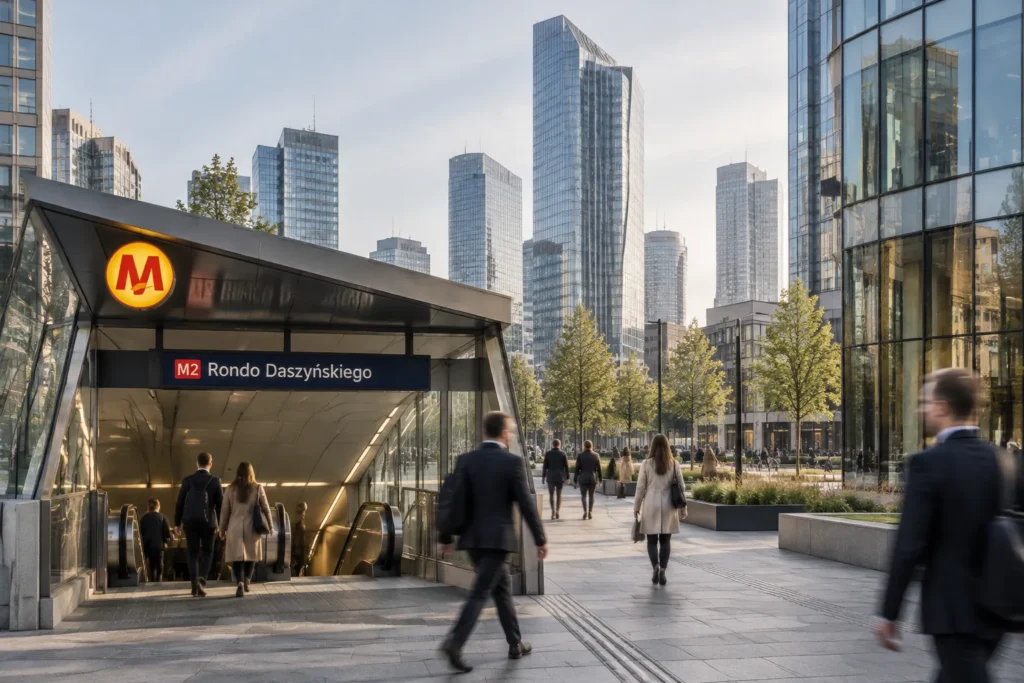
Those figures do not prove that every central building is prime. They prove something narrower and more useful: supply and occupier demand differ dramatically from one submarket to the next.
Micro-location narrows things further. Two buildings in the same district can differ markedly in walking distance to a Metro station, tram connections, the street life around them and access to arterial roads. A few hundred metres on the map can decide whether a tenant’s staff arrive by metro in ten minutes or spend twenty in traffic.
Scarcity: the part of the definition people skip
A good address becomes an economic asset when comparable alternatives are hard to create or acquire. That scarcity can come from limited land, zoning and heritage constraints, a shortage of modern buildings in the area, or the simple impossibility of reproducing a particular view, frontage or corner plot. It is not the same as a temporary undersupply, which a construction cycle can fix within a few years.
Equity investors call this kind of advantage a moat: a competitor cannot simply replicate the business. Prime property has a spatial version of the same thing. The test is whether a developer could build an equivalent substitute next door.

How prime is defined in Warsaw
In Warsaw, «prime» has to be established against local submarket evidence. Importing thresholds from London, Paris or Berlin does not work.
The city’s fundamentals explain why the market has depth. According to the Statistical Office in Warsaw, the city had 1,866,729 residents at the end of 2025. In July 2026 it recorded more than 1.1 million people in average employment, with unemployment at 1.6%. None of that identifies a prime asset on its own. It does describe a labour and consumer market large enough to support a genuinely competitive top tier.
What the office market data shows
Offices give the clearest quantitative evidence of the gap between ordinary and prime space.
CBRE put Warsaw’s modern office stock at roughly 6.24 million sq m at the end of June 2026, with only about 130,000 sq m under construction. BNP Paribas Real Estate reported around 529,000 sq m of available space, about 22% less than a year earlier. Other analysts describe this as the lowest availability since Q2 2020. Buildings completed within the previous five years had a vacancy rate of just 2.1%.
| Indicator | Warsaw overall | Central / top-quality segment | What it signals |
|---|---|---|---|
| Modern office stock | ~6.24m sq m | — | Size of the competitive field |
| Vacancy rate | 8.5% | 4.8% (central) | Central availability is far tighter |
| Non-central vacancy | 11.8% | — | Location still sharply differentiates assets |
| Vacancy, buildings ≤5 years old | — | 2.1% | Strong preference for new stock |
| Prime headline rent, centre | — | €22–30/sq m/month (varies by adviser) | Top space is being competed for |
| Space under construction | ~130,000 sq m | Over 90% in central locations | Pipeline remains thin |
Sources: CBRE, BNP Paribas Real Estate, Axi Immo, Q2 2026. Advisers define “prime rent” differently, so headline figures differ between reports.
The spread in the rent row deserves attention. BNP Paribas quotes headline rents of up to €30 per sq m. Axi Immo gives a central range of €22–28. Cushman & Wakefield had the centre at €24–28 at the end of 2025. Even professional advisers draw the prime boundary in slightly different places. That is one more reason to treat “prime” as a conclusion you reach yourself, not a figure you copy from a report.
Is expensive property automatically prime
No. A high asking or transaction price may reflect scarcity, a luxury specification or a temporary market condition. None of those, taken alone, establishes durable prime status.
Warsaw’s residential data shows the problem. CBRE reported an average asking price of PLN 18,153 per sq m for new apartments in Q2 2025, with 17,011 developer units on offer. Transaction data from the public price register (RCN), processed by GeoCeny, gives a 2025 median of PLN 15,439 per sq m across about 31,800 qualifying sales. The middle half of transactions ranged from PLN 13,267 to PLN 18,332.
An apartment priced well above those benchmarks clearly carries a premium. What the price does not tell you is why, or whether the reason will still hold in ten years.

A working checklist for testing prime status
Prime assessment works best as a set of questions with evidence behind each one, not a single threshold.
| Factor | Evidence to examine | Warning signal |
|---|---|---|
| Micro-location | Transport, walkability, surrounding uses, street quality | Prestigious district, weak immediate surroundings |
| Scarcity | Comparable sites, competing stock, planning pipeline | Large pipeline of close substitutes |
| Demand | Vacancy, absorption, transaction volumes, buyer pool | Price unsupported by completed deals or occupancy |
| Building quality | Age, building systems, floor plates, adaptability | Functional or technical obsolescence |
| Energy performance | Energy certificate, actual consumption, HVAC and controls | High operating costs, looming retrofit |
| Liquidity | Comparable sales, time on market, depth of buyers | Very thin resale market |
| Income quality | Lease terms, tenant covenant, occupancy history | Headline rent masking incentives or vacancy |
| Future resilience | Local plan, infrastructure projects, regulation | Value depends on conditions likely to worsen |
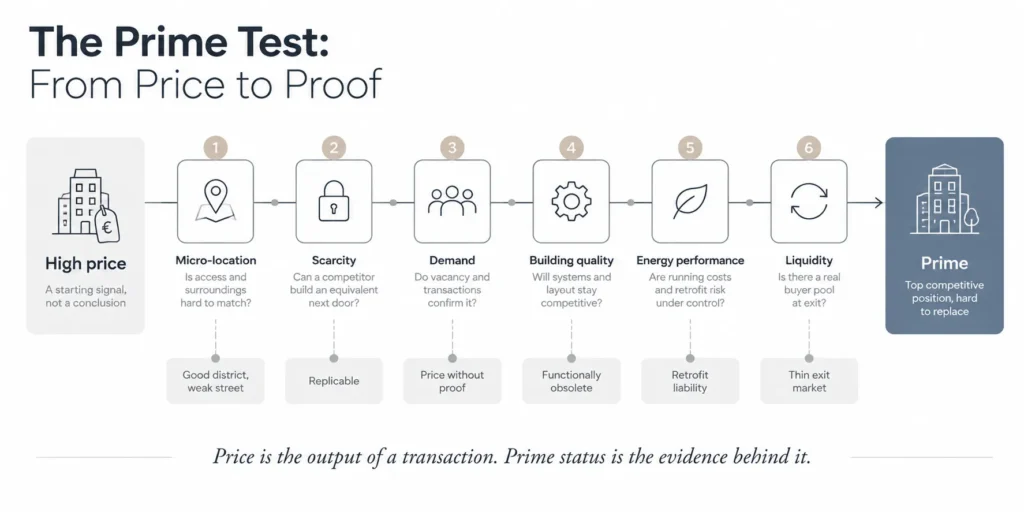
The framework guards against the most common analytical slip: treating observed price as proof of underlying quality. Price is what a transaction produced. Prime status is about the characteristics that should keep producing it.
From address to asset: how the definition has shifted
For most of the market’s modern history, «prime» meant the right address. Increasingly, it means the right address plus a building that still performs.
Warsaw’s office history makes the shift visible. In Q2 2011, prime city-centre rents were around €22–25 per sq m per month, and vacancy in modern stock was 6.2%. The development wave that followed expanded the map of high-quality offices. By the end of 2013, Warsaw had more than 4.1 million sq m of modern stock, and schemes such as Warsaw Spire and Q22 went on to redraw the business district around Rondo Daszyńskiego.
The logic of that era was simple. Either you built new Grade A space, or you kept an older building running because its location would carry it. The weakness of the second option surfaced gradually, as energy costs rose, tenant expectations moved on and the technical gap between old and new stock widened.
Owners of ageing buildings were left with two main paths: deep refurbishment or conversion to another use. Neither is automatically economic. Keeping the structure saves embodied carbon and construction cost, but floor-to-ceiling heights, column grids or structural loads can stop a refurbished building from ever competing head-on with new stock.

The market has started to act on that. Savills reported that more than 152,000 sq m of Warsaw office space left the stock during 2025 through demolition or change of use. Deloitte notes that most withdrawn buildings pre-date 2000 and typically combined high energy consumption with limited adaptability. Much of that space sat in Służewiec, and a good deal of it is being redeveloped for housing.
The practical lesson adds a layer to the old definition. The land stays where it is, but a building on prime land can stop being a prime building.




Why does building quality now decide prime status
A strong location cannot fully compensate for obsolete systems, inefficient layouts or operating costs that drive tenants away.
Regulation reinforces the point. Under Polish rules, an energy performance certificate must be provided when a building, part of a building or a unit is sold or let. At EU level, the recast Energy Performance of Buildings Directive entered into force in 2024. Poland’s Ministry of Development and Technology frames its purpose as reducing energy use and costs in buildings, raising standards and cutting emissions.
This creates a clear trade-off. An older central building may offer an exceptional address at a lower entry price. In exchange, the buyer takes on refurbishment exposure, technical obsolescence risk and higher running costs. A new building reverses that bargain: modern systems, efficient floor plates and better environmental performance improve its competitiveness, and the investor pays for them up front.
Four quiet ways a prime building loses its status
The parts of a property that nobody photographs often decide how it competes.
Age is a proxy, not a measurement. The 2.1% vacancy in buildings under five years old, set against 8.5% for the city, shows a strong occupier preference for recent stock. Age and quality still are not interchangeable. A well-refurbished 2005 building can outperform a mediocre 2021 one.

Supply can shrink as well as grow. Anyone tracking only the construction pipeline misses half the picture. A market tightens when demand rises, when development slows, when obsolete stock is withdrawn, or through all three at once, which is roughly what Warsaw has seen since 2024.
Functional obsolescence arrives before physical failure. Ventilation, building management systems, lift capacity, floor plate efficiency and metering can fall short of occupier expectations long before the concrete frame shows any sign of age.
Energy performance has a direct financial channel. It feeds into service charges, retrofit capex, lender appetite and, ultimately, leasing competitiveness. An “ESG” label on its own says little. What matters is measurable evidence: the certificate class, actual consumption and the condition of the installed systems.
Put simply, prime status is not a photograph of a building. It is a running record of how that building competes.
How can investors put a number on the prime premium
Test the premium through income, vacancy, operating costs, exit assumptions and comparable transactions. Price per square metre alone will not tell you much.
For an income-producing property, the basic capitalisation relationship is:
Value = \frac{NOI}{Cap\ Rate}
Here NOI is annual net operating income before financing, and the cap rate is the yield an investor requires on that income.
This formula explains why two buildings with similar rents can be worth very different amounts. If the market sees one income stream as more durable, because it has lower vacancy risk, less obsolescence exposure and easier re-letting, investors will accept a lower cap rate. That means they pay more for every euro of current income.
The sensitivity is larger than most people expect. Take a building producing €1,000,000 of NOI:
- at a 5% cap rate it is worth about €20.0 million;
- at 6%, about €16.7 million;
- at 7%, about €14.3 million.
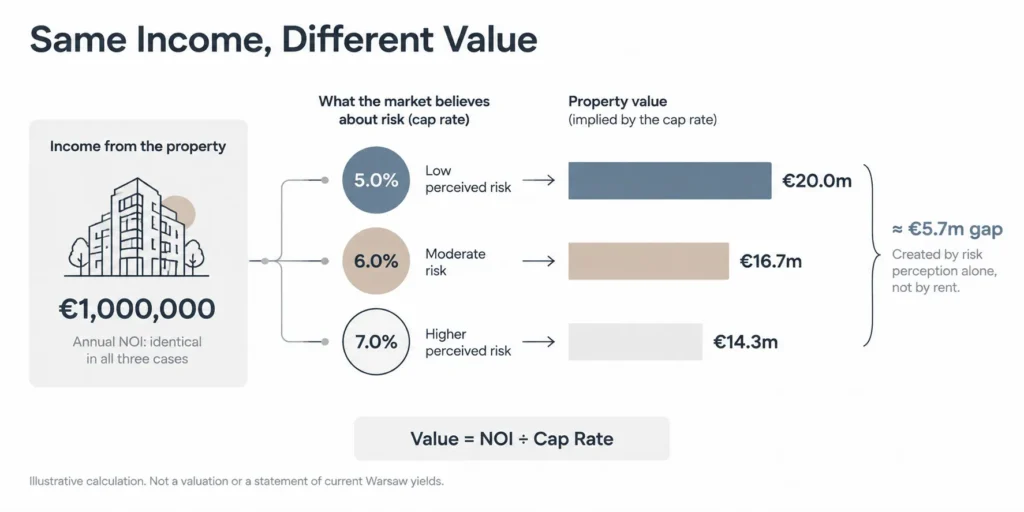
Two percentage points of perceived risk move the value by almost €5.7 million, with no change in the rent roll. These are illustrative calculations. They are not a valuation or a statement about current Warsaw yields.
The arithmetic shows why a prime acquisition is not automatically the safer one at any price. Accepting a lower yield in exchange for perceived security means giving up current income. If the scarcity you paid for later turns out to be replicable, the prime label will not protect the capital.
Does prime real estate hold its value better
Prime characteristics support resilience. They do not make an asset immune to cycles.
The strongest evidence is relative. In Q2 2026, central Warsaw offices were running at 4.8% vacancy while non-central ones were at 11.8%, and buildings under five years old were at 2.1%. At this point in this market, location and quality clearly correlated with very different availability conditions.
That is a long way from a universal rule that central assets always outperform. Property values respond to interest rates, economic growth, new supply, tenant behaviour and the returns investors require. A highly defensible building can still lose value if cap rates move out far enough. Prime assets tend to fall less and recover faster, but they do fall.
The accurate way to describe “prime” is relative competitive strength, not protection from repricing.
Case in point: when location stopped being enough
Warsaw’s ageing office stock shows how prime land and a prime building can become two separate propositions.
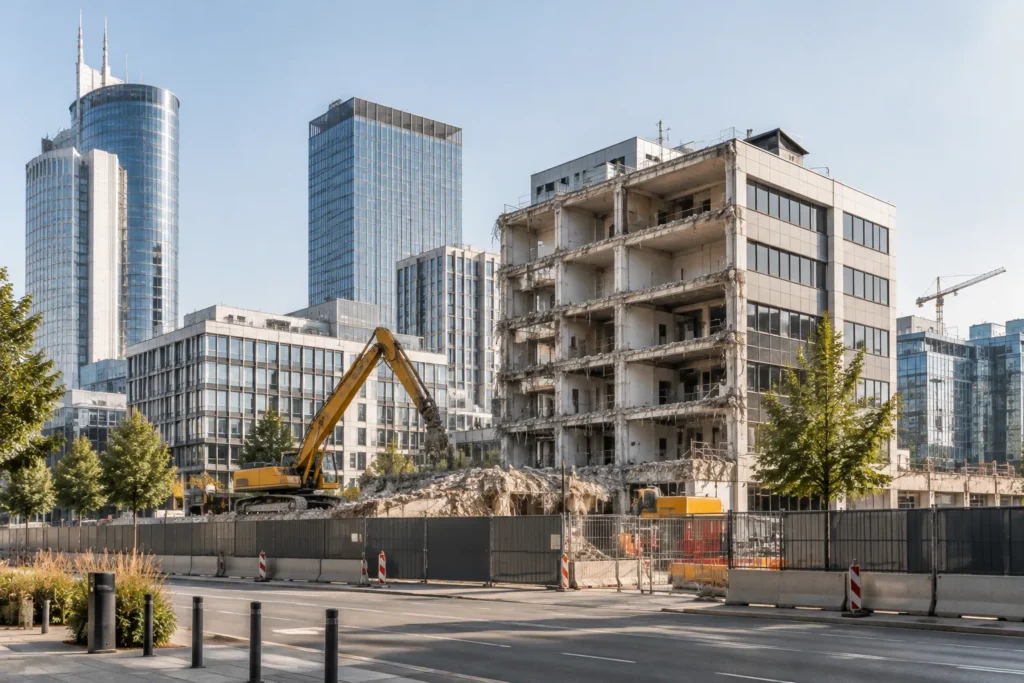
The situation. A large group of offices built in the 1990s and early 2000s sat in established locations, many of them within reach of the centre, and saw their competitiveness erode as tenant requirements and energy standards moved on.
The response. Owners weighed refurbishment, conversion, continued operation at falling rents, or demolition and redevelopment. Few could simply rely on the address to keep the building let.
The outcome. Savills recorded more than 152,000 sq m leaving Warsaw’s office stock in 2025 through demolition or conversion. Over the same period, the newest buildings were almost fully let, at 2.1% vacancy in Q2 2026 according to BNP Paribas Real Estate.
The takeaway is uncomfortable for anyone who equates prime with postcode. The land under those buildings may keep much of its strategic value. The structures standing on it did not.
When is paying the prime premium a mistake
The strongest argument against prime is simple: an excellent asset can still be a poor investment if the price already assumes too much future success.
Prime property usually trades at the tightest yields in the market. That leaves little room for error and limited upside from yield compression, because most of it has already happened. If rents stall, the investor holds a low-yielding asset with little margin to absorb rising costs.
Meanwhile, some of the best returns in a market like Warsaw come from assets that are not prime today but could become so. Examples include a well-located older building that can be properly refurbished, a residential plot near a planned metro extension, or a district whose surroundings are improving faster than its prices. These strategies carry more execution risk. They also carry a margin that fully priced prime assets rarely offer.
There is also a liquidity paradox. Prime assets are generally the easiest to sell, but at the very top end, such as trophy offices or exceptional penthouses, the buyer pool can be surprisingly thin. When few buyers can write cheques of that size, exit timing becomes a risk in its own right.
None of this argues against prime property. It argues against paying for the label instead of the attributes.
So how should you use the word «prime»
Use it as a hypothesis to test, not a description to accept. A property earns the word when it holds the top competitive position in its own submarket and the evidence shows that position is hard to replicate. That evidence includes vacancy, transactions, building quality, energy performance and the pipeline of competing supply.

In Warsaw, the evidence currently points in a clear direction. Location still separates winners from the rest, but it is no longer enough on its own. The assets that command the tightest vacancy and the strongest rents combine a central or well-connected position with a building that still meets modern technical and energy standards. Those that rely on the address alone are, quite literally, disappearing from the stock.
Frequently Asked Questions
What is the difference between Class A and prime real estate?
Class A (or Grade A) is a technical rating of the building itself: its specification, systems, floor plates and management standard. Prime is a market verdict. It adds location, depth of demand and the scarcity of comparable alternatives. Every prime office is usually Class A, but not every Class A office is prime. A new, well-specified building in an oversupplied or poorly connected zone keeps its grade but loses the pricing power that defines prime.
How does prime real estate compare with investing in corporate bonds?
Both provide contractual income, but the risks differ in structure. A bond pays a fixed coupon and returns its nominal value at maturity, and its main risks are default and interest-rate moves. Prime property pays rent that can grow with indexation. It has no maturity value, though, and it adds costs bonds do not have: vacancy, capex, management and slow, expensive exits. Investors therefore expect a property yield above comparable bond yields as compensation for illiquidity and operational risk. When that spread narrows too far, bonds often become the more rational choice.
Why are prime yields in Warsaw higher than in Western Europe?
Prime office yields in Warsaw have hovered around 6% recently, while the European average sits roughly between 4.9% and 5.4%, depending on the adviser and whether London is included. The gap reflects a higher risk premium, not weaker buildings. The drivers are a smaller and less liquid investor pool, currency risk for euro-based capital in a zloty economy, higher local interest rates and a perception of geopolitical exposure. For investors, this cuts both ways: higher entry income, but more sensitivity to shifts in sentiment towards the region.
Which performs better: prime residential or prime office property?
They reward different strategies. Prime offices in Warsaw are typically let in euros on multi-year leases with annual indexation, so income is more predictable, but capital values are closely tied to yield movements and tenant demand. Prime residential offers lower gross rental yields, especially in the most expensive districts. Its returns rely more on capital appreciation, and it is let in zloty on shorter, tenant-protective contracts. Offices suit income-focused institutional capital. Residential tends to suit private investors who can accept thinner income in exchange for a broad resale market.
Can prime property protect capital during inflation in Europe?
Partly, and mainly through the lease structure rather than the asset class itself. Warsaw office leases commonly include annual indexation to a euro-area inflation index, so rents follow prices with a delay. Prime residential rents do not index automatically and must be renegotiated. Inflation also raises interest rates, which can push yields up and values down even while rents rise. For family offices looking for a defensive CEE allocation, prime property works best as a long-term store of value with inflation-linked income, not a short-term hedge.
Which Warsaw micro-locations have long-term appreciation potential?
The strongest candidates are usually areas where infrastructure or regeneration is changing accessibility faster than prices are adjusting. Investors commonly watch Praga-Północ and Kamionek, where regeneration is supported by the M2 metro line, the Towarowa and Wola corridor, where the business district continues to expand, and districts along the planned M3 line towards Gocław. Established prime areas such as Powiśle or Old Mokotów offer stability but limited upside, because much of their premium is already priced in. Any location bet should be tested against actual construction timetables, not announcements.
How can you spot a development falsely marketed as «prime»?
Start with the gap between the marketing and verifiable facts. Warning signs include «minutes to the centre» claims measured by car outside rush hour, metro stations that are planned but not funded, guaranteed-return aparthotel or condohotel schemes, and renderings that crop out the surrounding streets. Check whether the site is covered by a local zoning plan (MPZP) or only an individual decision on land development conditions (WZ), review the building permit, and confirm that buyer payments go into an escrow account (mieszkaniowy rachunek powierniczy). Finally, compare the asking price with transaction data from the public price register (RCN), not with competitors’ price lists.
Sources
- Leni, What does prime real estate mean? — leni.co/glossary/what-does-prime-real-estate-mean/
- BNP Paribas Real Estate Poland, Office Market in Warsaw Q2 2026 — realestate.bnpparibas.pl/en/review-office-market-warsaw-q2-2026-0
- CBRE Poland, Warsaw Office Figures Q2 2026 — cbre.pl/insights/figures/warsaw-office-figures-q2-2026
- Eurobuild CEE / Axi Immo, Warsaw office market picks up in Q2 (2026) — eurobuildcee.com/en/news/36943-warsaw-office-market-picks-up-in-q2
- Cushman & Wakefield, Poland Office MarketBeat Q4 2025
- Statistical Office in Warsaw — warszawa.stat.gov.pl
- CBRE, Warsaw and Poland Living Figures Q2 2025 — cbre.com/insights/figures/warsaw-and-poland-living-figures-q2-2025
- GeoCeny, Apartment transaction prices in Warsaw — 2025 — geoceny.pl/en/warsaw/apartment-prices/2025
- Warsaw Office Market Profile Q2 2011 — bazabiur.pl
- City of Warsaw, Warsaw Investor Guide 2014 — en.um.warszawa.pl
- Savills / Officemarket.pl, Warsaw office market ended 2025 with record demand — officemarket.pl
- Deloitte Polska, Tylko cztery pozwolenia na budowę biur w Warszawie w 2025 r. — deloitte.com/pl
- Ministry of Development and Technology, energy performance certificates and EPBD — gov.pl/web/rozwoj-technologia